Electrical - the load step behind a dead screen
Your screen dies at the compressor click, then boots itself back up as if nothing happened. That's a supply problem far more often than a software one, and you can prove which in an afternoon.
The videos reach me every summer. Engine idling, a hand reaches for the A/C button, the compressor clicks, and the screen goes black for four seconds before the boot logo crawls back.
The driver always blames the unit, because that's what it looks like from behind the wheel, and I've fitted these screens for sixteen years without the A/C button being the fault more than a handful of times.
What actually happens is that a clutch, a blower on full and a condenser fan all switch on within a second of each other, and the supply to your head unit can't hold voltage through that step, so it reboots to protect itself.
So the useful question isn't why the A/C kills your screen. It's which part of the supply gives up first, and only three candidates exist.
The short version
Three faults get called random shutdown, and only one is worth chasing with a meter. Watch your screen next time.
One clue beats the rest: if your clock and presets survive the event then the permanent feed held on and only the ignition sense dropped, but if the clock resets to 00:00 the main feed was interrupted, so start at your battery, the fuse and the plug.

Do these first, in this order, because each one removes a branch of the fault tree. What I see most often is a driver who replaced the unit before running test one.
If nothing reproduces on a cool morning, park in the sun for twenty minutes and retry, because heat raises resistance in a tired connection, and in our experience plenty of these cars only fail on the second start of a hot day.
Here's the step you skip, and it's why so many cars end up with a new battery, a new unit and the same reboot, because your battery can sit at a cheerful 12.6 V while the radio cavity sees 10.8 V.
Set your meter to DC volts with min/max capture, back-probe the plug with the unit running and then press the A/C, because the dip lasts a fraction of a second and a live reading will settle back and tell you nothing. Frustrating, but that's the whole trick.
| Reading | Probes | Workable target | What a bad number means |
|---|---|---|---|
| B+ at rest | Plug B+ to chassis, key off, lights off | 12.4 V or more | A tired battery, or a feed wire with corrosion in it |
| B+ lowest point | Same pair, meter on min/max, A/C pressed | Stays above 11.5 V | The feed collapses at the load step, which is your reboot |
| ACC lowest point | ACC pin to chassis, A/C pressed | Stays above 11.5 V | The sense line shares a load circuit and reads key-off |
| Ground drop | Battery negative to radio case, loads on | Under 0.10 V | Resistance in the earth path, often at a shared stud |
| Charging at idle | Battery posts, engine running, lights and fan on | 13.8 - 14.4 V | Alternator, belt or a slipping pulley, and the whole car sags |
How I read it: if B+ dips while the ground drop stays clean, the fault is upstream in the feed. If B+ holds and the drop is over 0.10 V, go find your earth point.
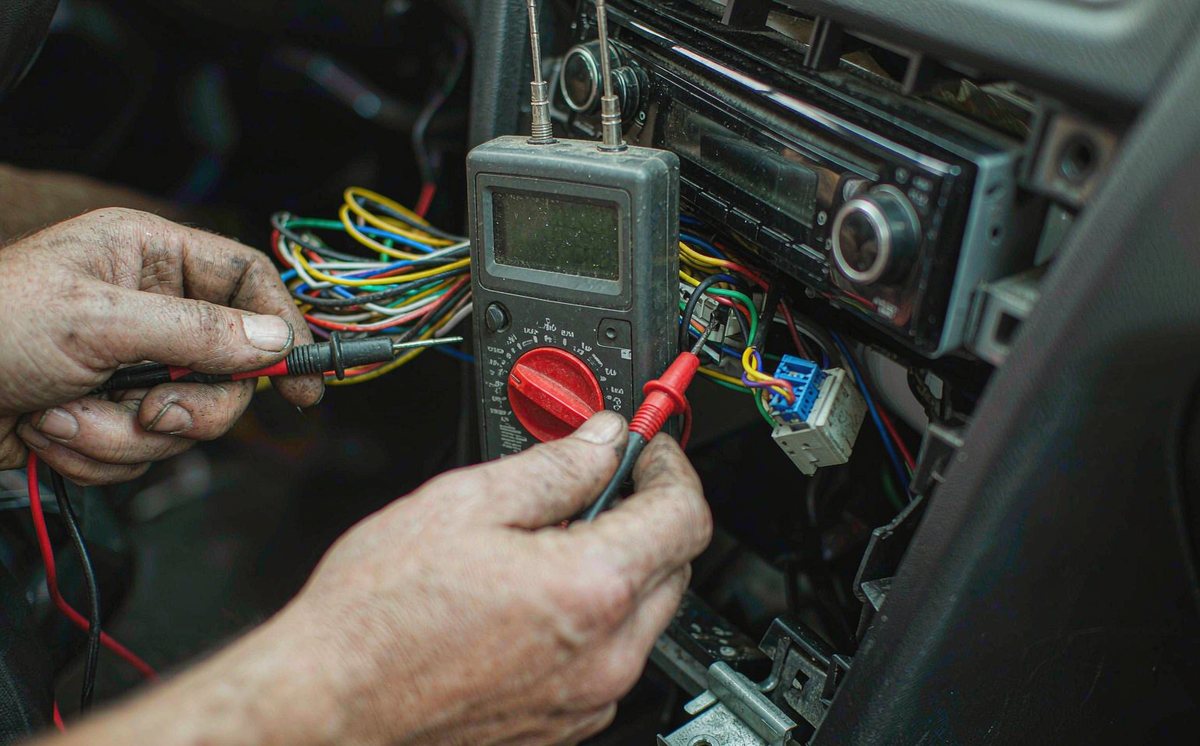
Behind your dashboard there's usually one stud doing several jobs, and the blower, the climate panel and the radio tend to share it. Let it go loose, painted over or furred with white corrosion, and the blower's current pushes the local earth up a few tenths of a volt. Your unit isn't measuring volts to the battery, it's measuring volts to whatever its earth terminal sits at.
The test needs no disassembly: one probe on the battery negative, one on your radio case, blower to full, and anything above about 0.10 V is a fault while half a volt will reboot a cold unit every time.
The same earth is the usual suspect on a retrofit android head unit for older car job, because the factory point was sized for a radio drawing two amps and you've added a screen, a fan and a camera. Confirm whether your car is LHD or RHD before assuming your earth points sit on the driver's side, since on many models built for Europe they follow the steering column.

This one hides hardest. On a quick install the ignition sense gets picked from whatever fuse is nearest and already switched, and the blower fuse usually is. It'll work for months, then the fan hits maximum, ACC dips, your unit decides the key came out, and it'll shut down in an orderly way instead of crashing. From your seat that looks identical to a random reboot, which makes it awkward to argue about.
You can test it without a meter. Pull the blower fuse, repeat the A/C test, and see whether the screen survives. Then trace ACC and move it to a key-on circuit carrying nothing heavy. A proper android car stereo wiring harness adapter gives you a dedicated ignition pin.
With an add-a-fuse, check the rating against what your unit draws, not what the listing claims, and check the crimp too, because a loose crimp on a 15 A circuit runs warm and a warm crimp works loose. That's maddening when you've already paid for a battery.
The evaporator drains through a small hose behind your dash, and a blocked hose sends condensate to the lowest point, often the top of your head unit. Damp case, musty smell, condensation on the glass when you switch off: check those before you buy parts. Water faults get misdiagnosed as power faults more than any other.
I've found that worn brushes arc as the fan spins, that noise rides along the feed, and you get touch glitches rather than a clean reboot as the fan speeds up.
If the screen misbehaves only when you touch a climate button and recovers without rebooting, it isn't losing power; it's reacting to a bus message. Check the android head unit CAN bus decoder box and its vehicle profile before touching the feed.
Sort the fault into these four boxes before reaching for a part, and you won't buy the wrong thing twice.
Black screen at the compressor click, boot logo, presets intact, and it happens more often on a hot restart.
The feed or earth can't hold voltage through a step of ten to twenty amps, so the unit drops below its own cut-off.
A temporary fused lead from the battery to B+, plus a cleaned earth stud. Reversible, and it proves the diagnosis.
Re-terminate the earth, move the ACC tap to a clean key-on circuit, and fit a harness sized for the load.
When the readings are clean, the earth is solid and ACC has its own circuit, the fault sits inside the unit and no harness work will save it.
Ask any seller two things: what input voltage range your unit is rated for, and whether the ignition sense is filtered against short dips. A seller who answers with a figure understands the problem; one who says it's very stable hasn't tested it. The harness that carries each wire matters as much as the unit, which is why WITSON lists ours per model. If you haven't picked a unit yet, start from the range we build and check the feed rating first.
Once your wiring is proven, a unit that still reboots is a warranty question rather than a wiring question. The terms cover what happens next.
Read the warranty terms01Why does my car screen turn off only when I turn on the A/C?
Because the A/C is the biggest electrical step your dash sees in normal driving. Clutch, blower and condenser fan engage together, and a feed that's marginal elsewhere fails at that moment. If your screen's stable with the fan on maximum and the compressor off, the clutch circuit is what tips it.
02Can a weak battery do this if the car still starts?
Yes. Cranking needs a short, heavy burst, and a tired battery can deliver that while sagging under a steady extra load.
03Can I keep driving while the screen reboots?
The reboot isn't dangerous, but the same drop reaches every other module on your car, so treat it as a warning and check the earth and the charging voltage before a long trip.
04Do I need a voltage stabiliser or a capacitor?
Not as a fix. A capacitor'll hide a dip for a fraction of a second, which makes the symptom vanish while the resistance stays in the loom and keeps growing. Find the drop first, then decide.