DHB / DHV / DHF / DHE - new Bluetooth call layer, shipping now
You're at 70 mph on concrete and the person on the line asks whether you're next to a jet engine. A louder speaker won't fix that, and neither will another menu. The DH series now runs an AI noise-reduction stage on the Bluetooth call path, so the other end hears your voice, not your tyres.
Every handsfree call has two directions, and owners only upgrade one. Downstream is the easy half: a bigger screen, a cleaner amp. You hear the caller better and the job looks finished.
Upstream is the half nobody photographs. It runs from the capsule to the Bluetooth link to whatever phone is on the other end, and everything your mic picks up goes out, including the parts you'd rather it dropped: wind off the top of the door, tyre roar through the floor pan, the blower.
The old fixes work, up to a point. Turn the mic gain up and you amplify the noise with the voice. Fit an external microphone and you've fixed half of it, because placement still decides what your capsule hears. I've heard that story end the same way: new mic, same complaint, and a maddening afternoon gone.
So there are three layers, and most cars only get the first two. Placement. Gain. And now a stage between the capsule and the Bluetooth stack.
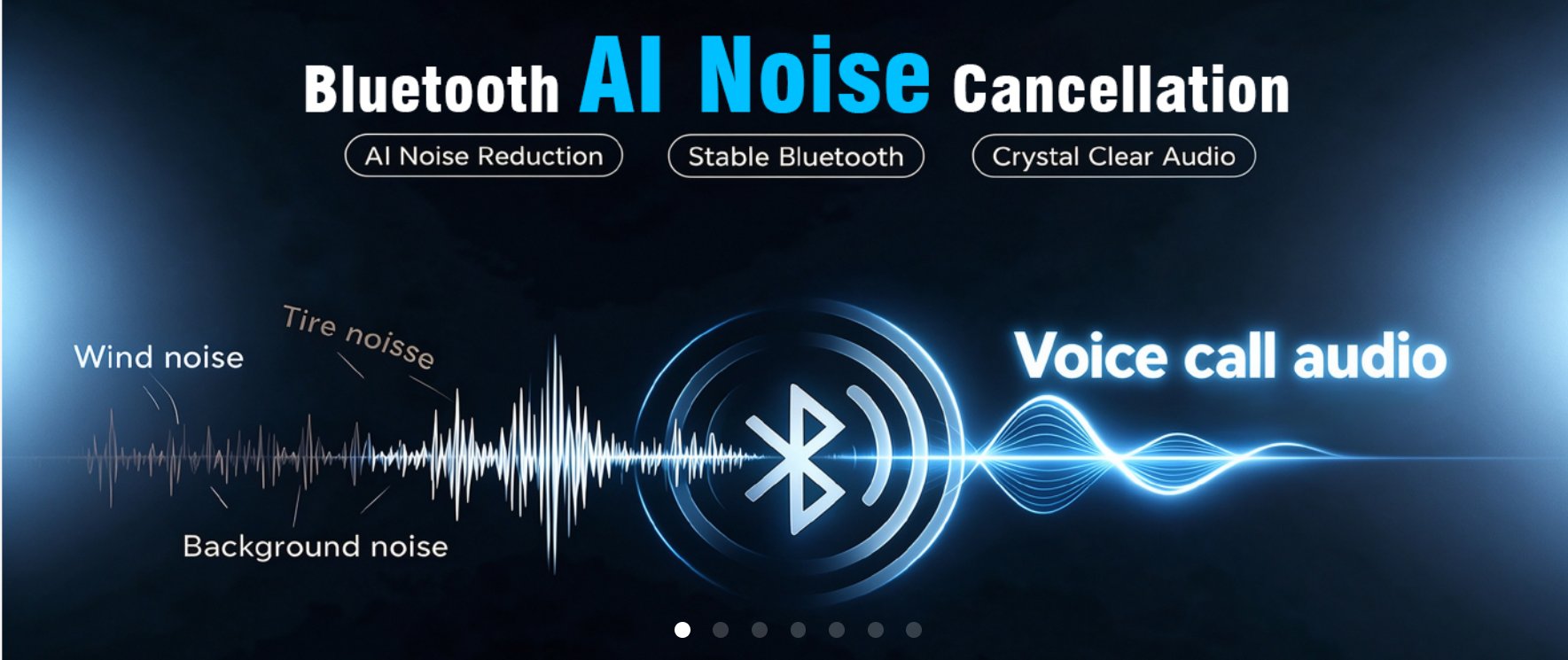
The three noise sources on the poster are the ones that ruin a call. Wind noise is a hiss with no pitch, tyre noise comes up through the floor as a low rumble that sits on top of a male voice, and background noise is everything else: passengers, the blower, a phone in the console.
Speech isn't like any of them. It starts and stops, and its energy moves around. A steady rumble doesn't. The AI stage works on that difference: it keeps what behaves like speech and pulls down what behaves like a machine. That's why it sounds like a phone call, not a recording of a car.
Three claims sit under the headline. AI Noise Reduction is the processing. Stable Bluetooth is the link holding its bitrate when the cabin gets loud. Crystal Clear Audio is the outcome you judge on the other end.
I'm not going to hand you a decibel figure, because the published material doesn't quote one, so any number here would be invented; judge it by section 04.
The DH family runs the UIS7865, an octa-core at 2.2 GHz, on Android 16. Memory runs from 4 GB with 64 GB to 8 GB with 128 GB, on a 9 to 10.2 inch 1280x720 QLED with 2.5D arc glass. What's new is the call path on top.
Two microphones matter: there's a built-in capsule in the faceplate and an input on the rear harness for the external microphone that comes in your kit, and both feed the same stage, which is why placement still counts.
Wireless CarPlay and Android Auto calls take the same route, so the feature isn't limited to the radio's own phone book. The 4G modem is separate: noise reduction works with no data at all, which matters in a dead spot. Steering wheel controls still answer and hang up over CAN bus, so you never touch the screen mid-call.

The clip below is a call recorded in a moving car. Listen to the person being called, not the presenter: does your voice arrive clean, and does the noise behind it sit low enough to ignore?
Run the same test in ten minutes, because cabin noise varies more than a spec sheet admits: park with the engine running and call your voicemail, take the same call at 60 km/h on a coarse surface, then crack the window an inch and repeat, which is the tedious part.
One setting to check before you blame the radio: set the phone's call volume first, then bring the mic gain down rather than up. High gain is the quick way to make a clean capsule sound like it's underwater. That's the awkward one I hear about most.
No processing stage can remove a noise it never got a clean sample of. If your microphone sits beside an open vent, air shakes the capsule before the algorithm sees anything; move it to the A-pillar and the firmware has an easier job.
Two microphones running at once is the second trap, and it's a frustrating one to chase: if the built-in capsule and the external one are both live, they hear the same voice milliseconds apart and the result sounds hollow. Cover the faceplate hole and test again: if the call clears, that was the problem, not the software.
If your gain is already at maximum, the signal clips before it reaches the noise stage.
Open windows, a modified exhaust, a roof rack in crosswind: these are physical, and they'll still be audible. What changes is how far they sit behind your voice, and on a normal car at normal speed that gap is the difference between a call you cut short and one you finish.
Three DH builds share it; what changes is memory, storage and the frame.


Around the panel, this car multimedia player keeps the same hardware: a zinc alloy frame, 1080P video, WiFi, and optical plus coaxial output for cars with a factory amplifier. The 4 GB build handles navigation and calls, while the 8 GB build suits anyone using the car as a hotspot. Rear camera inputs are separate parts, and the panel drops into your dash fascia, same as the rest of the range. If you're pricing a stereo upgrade, the build decides the cost.
We ship worldwide, most often to Europe, the Middle East, Southeast Asia and Australia, and every kit carries the harness and microphone for the car it was ordered for. Planning a head unit upgrade? Tell us the car and build, and we'll confirm the connector set before shipping.
The platform page covers the full DHG / DHF / DHE specification: See the DH platform introduction.
Kits built on these boards are listed by car: browse car multimedia players.
Zhuhai WITSON Industrial Co., Ltd. - Tel: +86-756-8120312, 8120211, 8120212.
Tell us which DH build you need and which car it's going into. We'll confirm the harness and microphone kit first.
Check the DH platform and buildsThe DH series: DHB, DHV, DHF and DHE. It's a platform feature, not a single SKU, so it isn't tied to one screen size or one build.
It cleans what leaves your car, what you hear depends on the caller's phone and network, and the person who notices is usually on the other end.
No, the built-in capsule feeds the same stage, and the external mic is about position: an A-pillar mount sits further from your vents, so the algorithm starts cleaner.
Yes. Calls through CarPlay or Android Auto run over the same Bluetooth path, so the processing applies whether you dialled from the radio or the phone.
The processing sits on the call path. Music and the amplifier outputs are a separate route, so your DSP settings stay put.
That depends on the batch, and I won't guess. Send the model and a photo of the system screen and we'll tell you what that unit can take.
If you are an installer or wholesale partner interested in DHB/DHV/DHF/DHE bulk orders or custom fascia modification, reach out to our team for special terms and technical document packages.